Sunday, October 25, 2009

HDA: Haus der Architektur


The Haus der Architektur (House of Architecture, HoA) Graz is a non-profit association promoting and conveying architecture to the public and providing a plattform for architects, students and in general for people who are interested in architecture. The association acts as an interface between people producing architecture and people consuming.

The HoA was founded in 1988 and has been a forerunner for similar institutions in Austria and Europe. The honorary and unsalaried working managing board changes every two years and devises a programme for these two years.

The focus of the current programme is "everyday life in an architectural context" and consists of exhibitions, round-tables, lectures etc. to the sub-topics of working, living, protecting, consuming, believing and building.

The managing board is elected every two years in the general assembly and consists of 5 people who are either lecturing at the technical university and the technical college of Graz, or working in architectural practices.

Haus der Architektur Graz

presents:

Of people and Houses


Architecture from Styria.

Architecture Graz Styria Yearbook 2008/2009


The yearbook of House of Architecture Graz (Haus der Architektur Graz) published for the fourth time this year, presents a radical approach also in international comparative terms. As the only one of its kind in all of Austria regularly documenting both the best new buildings in the province and the winning project of the Architecture Award of the Province of Styria, the yearbook consciously overcomes the conventions of the usual periodicals in order to reach a broader audience stretching even beyond architectural specialists.

As this year's curator of the Architecture Award of the Province of Styria and publisher of the yearbook, Andreas Ruby, the renowned Berlin-based architectural critic, has selected for inclusion in the yearbook twelve new constructions from over eighty submissions for the Architecture Award. It was possible to acquire the services of the Mexican photographic artist Livia Corona for photographic documentation of the projects published in the yearbook. In contrast with classical architectural photography, which focuses on the building, Corona places the relationship between people and spaces under the spotlight.

The yearbook has been presented on October 12th in the context of the presentation of the Architecture Award of the Province of Styria. In addition, the photographic works by Livia Corona can be seen as part of the "Of people and houses – Livia Corona photographs architecture from Styria" exhibition. The exhibition starts on October 12th and will be shown in the House of Architecture until the 1st of November.

Marking the new publication "Of people and houses. Architecture from Styria. Architecture Graz Styria Yearbook 2008/2009" on November 13th Markus Bogensberger and Heinz Rosmann (House of Architecture Graz) will be talking about publication strategies for contemporary architecture with Ilka and Andreas Ruby (editors) and the co-editor of the Architecture in the Netherlands Yearbook, Roemer van Toorn, at the Berlin book dealers "Pro qm".


Pro qm

Thematic book dealer covering city,

politics, pop, economic critique, architecture, design, art & theory

Almstadtstrasse 48-50 D-10119 Berlin http://www.pro-qm.de/


Share/Save/Bookmark

Monday, October 19, 2009

Cuauhtémoc Suárez


, originally uploaded by Cuauhtémoc Suárez.


One of our members from México is a finalist in "Arte 40" from the radio station "Los 40 Principales" and we are supporting him, so please, vote !! , just fill in all the 5 stars in "votar" and that's it !!! It doesn't matter where you live, you can vote!
This support his carreer & us too !
THANKS.


Share/Save/Bookmark

Tuesday, October 13, 2009

I Use Perfume to Occupy More Space | The institutional space in a self-critical manner

I Use Perfume to Occupy More Space

Museo de Arte Carrillo Gil


This exhibition approaches the institutional space in a self-critical manner. With the purpose of reviewing the social mechanisms that generate the belief in the value of artistic creation, I Use Perfume to Occupy More Space intersperses commercial products, theoretical and literature tomes, films, cartoons, works from the MACG collection, and other contemporary artworks.

Such a grouping reveals the use of artistic references in advertising to endorse and characterize commercial products and insert these in the worlds of fashion, politics, and social life in general. These records are scrutinized through artistic projects that question such a legitimization mechanism, as well as the inherent vanity of the art-world system.

Similarly, the exhibition's title additionally alludes to several clichés concerning the artist's persona, such as that of the romantic bourgeois, the "aristocratic" dandy, the intellectual, the accursed, or the bohemian artist, among others.
It is well known that perfume, although invisible, is a cultural artifice that allows its users to stand out in a crowd, because it confers status or individuality. One might affirm that such an invention is able to consecrate, as well as set apart, its wearer from the common, the massive, or the prosaic. If we agree with the premise that anyone can pretend to be an artist in the contemporary art world and in the same manner anything can be regarded as a work of art, then perfume exemplifies these processes for legitimization.

Rather than solely representing a collection of works organized under a given theme or through the scope of the current prevailing tendencies, this exhibition is conceived of as a space that invites examination, contemplation of the structures that exist beneath the art world. The artistic projects that comprise part of this exhibit represent sociological research by means of the compilation of documents and other materials found in several fields of cultural production. The exhibit also includes reference materials such as books on literature and art theory, snips of Hollywood movies, and cartoons that ironize the art world's narcissism and arrogance. The combination of these devices leads to critical reflection on the institutionalization of art and the social and discursive frameworks that instill the belief in its value.

Whereas the Enlightenment in the Eighteenth Century established belief in the power of the artist – through the acknowledgement of his/her geniality and innate talent – today it would appear that this role has assumed a back seat to the ability of understanding the institutionalism of art through self-criticism: namely, the rationality of the critical models and judgments that coordinate the production, presentation, and circulation of what ultimately constitutes the visibility of the artistic. Among art professionals, only a few continue to believe in the romantic myths of the illuminated artist who constructs metaphysical truths. This new attitude is evidenced in works that convey viewpoints on this romantic belief of the artistic persona and the value of artistic work. At present, the contemporary artist is observed as more as a sort of sui generis researcher who acquires a socio-professional role by relying on processes or models of hybrid or heterogeneous knowledge that are capable of teaching critical, ironic, political, aesthetic, or philosophical approaches, thus expanding the ways in which we understand and configure our world.

The "perfume", then refers, to the insubstantiality of the aesthetic experiences in the period during which its critical status was institutionalized. The "perfume" is an invisible presence that enables "things" to circulate or to become visible as something different from their original condition. We could say that it is a strategy of occupation that affects the perceived and social environment in which it is inscribed. From this perspective, today's art world is similar to a fluctuating atmosphere.

The title I Use Perfume to Occupy More Space can be understood as an attitude of suspicion of the sociability rituals that shape the world of art.


Artists:
Gabriel Acevedo
David Alfaro Siqueiros
Daniel Andujar/Rogelio López Cuenca
Julieta Aranda
John Bock
Ximena Cuevas
José Clemente Orozco
Carles Congost
Dustin Ericksen/Mike Rogers
Paul MacCarthy

Curator:
Willy Kautz

Museo de Arte Carrillo Gil

I Use Perfume to Occupy
More Space

October 7 - January 3


Museo de Arte Carrillo Gil
Av. Revolución 1608
San Ángel
01000, México, D.F
55 50 62 60
55 50 39 83 ext. 120
http://www.museodeartecarrillogil.com


Share/Save/Bookmark

Thursday, September 17, 2009

DE LO MEJOR DEL AÑO: Proyectos Monclova+Nrmal+El Narval+La Galería en el Taller Mecánico


4 DE SEPTIEMBRE / NOCHE: Formó parte de Z.MACO MTY y ahora emigraron para ofrecer un art-exhibit en La Galería en el Taller Mecánico, situada en el corazón del Florklore del la Colonia regia Tampiquito:
Proyectos Monclova
( DF) .

El sitio El Taller Mecánico, mostro su multimodalidad convirtiéndose en galería. Los hosts, Los Hermanos Alvarez de El Narval : el proyecto de arte social , quizás, más interesante de estos tiempos. Siempre pisando bastante fuerte & de la mano del excelente crew de NRMAL , proporcionaron un espacio idóneo para las obras, logrando potenciar exquisita contemporaneidad .

La exposición contó con el performance del Colectivo El Resplandor : ruido, misticismo y mezcal , calentaron la garganta & el corazón de los asistentes.


Exponentes :
( click to enter gallery)
Alejandro Almanza Marcos Castro José León Cerrillo Aldo Chaparro Emilio Chapela Napoleón Habeica Adriana Lara Mario López Landa Jorge Méndez Blake Moris (Israel Meza Moreno) Omar Rodríguez-Graham Colectivo El Resplandor Marco Rountree Eduardo Sarabia Tony Solis


“El Gordo” y su ronda de "Hochos" ( Hot-dogs) hicieron la noche.


Excelente evento . Lo mejor del Año. Felicitamos al crew detrás de la concepción,
programación y ejecución de estas sólidas ideas.


Las Bellas Artes Org. New York, N.Y.


Share/Save/Bookmark

Sunday, September 13, 2009

DM Artchitecture : Arne Quinze


Arne Quinze's talent lies in his ability to fuse polar extremes - passion and chaos with controlled elegance. He creates immaculate, urbane and polished works that are balanced with a certain contradicting tension, giving them a refined yet exuberant appearance. He realizes his ideas with verve and is able to generate crossovers between art and architecture as if it's child's play.

His headquarters in Kortrijk, Belgium, are located in a complex of 10,000 square meters. A unique creative platform where Quinze has surrounded himself with architects, urban developers, product and graphic designers, video artists, copywriters and sculptors. The Art Studio in Miami is another volcano for his creative artistic outbursts. Every new creative breed captures his research and study on interaction, urbanity movement, speed and light in present-day society. Quinze scans a city in a blink of an eye and divulges the ongoing rhythm running through multifarious buildings and settlements expressing the continuously evolving of human beings and their surroundings. Man cannot survive alone, we find refuge in one another. Neglecting our human needs we live in an era where social interaction has been well-nigh diminished to nonexistent.


--
Share/Save/Bookmark

Tuesday, September 8, 2009

¿ Para que quieres una Musa si puedes tener Nueve ? | 9musas.MTY


¿ qué hacer hoy?
¿ qué eventos estarán en los mejores lugares?
¿ que onda con el arte, cultura y moda?
Todo esto lo puedes encontrar en la agenda cultural Nueve Musas. Una página fácil de navegar, y con mucha información sobre los eventos y noticias que acontecen en la Sultana del Norte y más. Con una extensa galería de fotos y registro de mail ( para que te lleguen saliditas del horno las sugerencias recreativas), 9Musas es un exitoso proyecto virtual, que a (relativamente) poco tiempo de haber salido, su estructura y diversidad de informacion a gustado a muchos, INCLUYENDONOS.
BONUS POINTS: LA SEÑORITA MIRHTA DE LA GARZA ( SI THE POSH GIRL ) ENCABEZA EVENTOS Y SIN TANTOS MODALES DE LA SEÑORITA GABI FUENTES... AMBAS MIEMBROS DE THE PIGMY DEER NETWORK.
Buen proyecto !

Share/Save/Bookmark

Monday, August 31, 2009

How it would be, if a house was dreaming | 555 KUBIK


The conception of this project consistently derives from its underlying architecture - the theoretic conception and visual pattern of the Hamburg Kunsthalle. The Basic idea of narration was to dissolve and break through the strict architecture of O. M. Ungers "Galerie der Gegenwart". Resultant permeabilty of the solid facade uncovers different interpretations of conception, geometry and aesthetics expressed through graphics and movement. A situation of reflexivity evolves - describing the constitution and spacious perception of this location by means of the building itself.

Production: urbanscreen.com

Art Direction: Daniel Rossa - rossarossa.de

Technical Director: Thorsten Bauer
3D Operator: David Starmann shineundsein.de
Sound Design : Jonas Wiese

Realized with mxwendler.net mediaserver
Share/Save/Bookmark

Friday, August 14, 2009

Exposición Fotográfica Colectiva | LA FEMME / MTY,NL MEXICO

Por este medio se les hace una cordial invitación a la inauguración de la exposición La Femme en el estudio fotografico de Mysol Gonzalez.

Se llevará a cabo el 27 de agosto a las 21:00 horas.
ubicado sobre la Calle Aramberri 1702 esquina con América.
Centro de Monterrey.

Dicha exposición permanecerá abierta al público solo el dia del evento.

-


Cajafresca
Caleb Rocha
Cecy Young
Ernesto Falcón
Gerardo Otoniel
Jaime Campos
Luis Méndez
Lolita
Mariana García
Maria Tretto
Max Alarcón
Mike Durán
Mysol González
Samuel Catherine


Música
El Gato Raro
Gilo www.myspace.com/gilolopez
Leo Marz www.losmediaticos.com
Lechero Pastrana www.myspace.com/hyperlacte
o


Jueves 27 de agosto
9 p.m.
MYSOL STUDIO.
Aramberri 1702 pte. esq. América
Centro MTY NL.

info@mysolfoto.com

Share/Save/Bookmark

Saturday, August 8, 2009

THE PIGMY DEER NETWORK : UN PROYECTO DE LAS BELLAS ARTES, CUMPLE UN AÑO.

"The project was born out of a desire to provide art- based bussiness solutions in Mexico, as well to develop New Business in Merge Mexican Art & Design in some of the most important cities of the world .We are an active net, creating . We are the Mexican Talent Stock "
The Pigmy Deer Network Official Presentation. MR. 2008
...........................................................................................................................................................................................................


El 21 de Agosto del presente, se celebra el primer año desde que nació el proyecto The Pigmy Deer Network. Nació entre el DF, Chihuahua, y Guadalajara , pero fue en la Ciudad de León , Guanajuato, donde se abrió la primera sede oficial del Primer Stock de Talento Méxicano. Después de tan solo 6 meses de trabajo intenso por parte de los miembros del colectivo, ya contaba el mismo con diversas publicaciones, invitaciones a participar en ferias de arte, dos galerías urbanas, y diversa participación en el medio del talento emergente mexicano. Más de 600 mails diarios fueron leidos. Actualmente, el stock está integrado por 500 miembros entre artistas,comunicologos,arquitectos, publicaciones,diseñadores, etc..

The Pigmy Deer Network se asocia con Las Bellas Artes al poco tiempo, una empresa Mexicana cuya sede se encuentra en Nueva York , y cuyos fines y visión concuerda perfectamente con la que el Primer Stock de Talento Mexicano venia trabajando desde antes. Es asi como The Pigmy Deer Network, es ahora un proyecto coordinado por Evangelina Guerra Lujan, Katro Rodriguez y Gustavo Ortega, Directores Creativos de Las Bellas Artes.

En febrero del 2009, Las Bellas Artes tiene sede en Barcelona, Nueva York, & Monterrey, apuntando a diestra y siniestra y predicando la misión del Stock de Talento Mexicano: Creer y Crear. Desde este momento se comienza un nuevo proyecto: Transatlanticismo.

Un año se dice muy facil, y más, cuando esta es una de las frases mas trilladas, pero The Pigmy Deer Network , sigue dando pequeños pasos hacia un compromiso: Creer y Crear. Creer en el Nuevo Talento Mexicano. En las voces creativas. En las buenas ideas. En las alianzas, el trabajo en equipo, y claro , en México.

Un añito señores....
Un añito !


¿ Como celebramos?

Esperen una publicación especial, una especie de anuario, donde se publicarán: colaboradores, los miembros oficiales del colectivo, perfiles, book, y claro... el recuento de donde y cómo se participó el pasado año.

El yearbook se distribuirá transatlaticamente!

Felicidades Pigmies!!!!!!!!!
Share/Save/Bookmark

Friday, July 3, 2009

Calaf és teu | Llegir la Ciutat : Un proyecto por Daniela Monterrosa y Evangelina Guerra para IDensitat # 05


El resultado de dos días intensos de desarrollo proyectual acompañado de una semana de debates, teoría y recorridos. La pieza resultado es un MANUAL para la gente de Calaf, donde puede intuir cómo mediante un proceso de adición de elementos y actividades en un solar, puedes tener TÚ jardín temporal, Tú Calaf. Este proyecto lo realizamos , la ARTquitecta Daniela Monterrosa y yo, a quien doy las gracias por compartirme esa visión Chilena tan particular, de descubrir, probar, recorrer, ser curioso, equivocarte, y volver a empezar. Este proyecto, sin su creatividad tanto manual como ejecutiva, no la hubiesemos logrado.
Un video a manera de intro creación de la Arq. Daniela Monterrosa para el proyecto .


Share/Save/Bookmark

* IDENSITAT


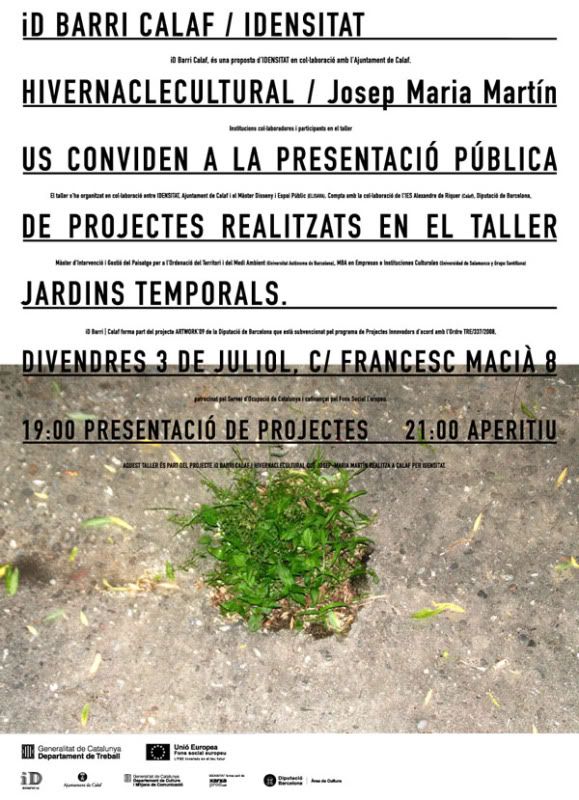
iD BARRI CALAF / IDENSITAT HIVERNACLECULTURAL /

Josep-Maria Martín Us conviden a la presentació pública dels projectes realitzats en el taller Jardins Temporals. Divendres 3 de Juliol a les 19:00h, C/Francesc Macià 8 Calaf.
iD Barri Calaf, és un projecte d’IDENSITAT en col·laboració amb l’Ajuntament de Calaf, Diputació de Barcelona i el Màster en Disseny i Espai Públic (ELISAVA).
Compta amb la participació de l'IES Alexandre de Riquer (Calaf), Màster d’Intervenció i Gestió del Paisatge per a l’Ordenació del Territori i del Medi Ambient (Universitat Autònoma de Barcelona), MBA en Empresas e Instituciones Culturales (Universidad de Salamanca y Grupo Santillana).iD Barri Calaf forma part del projecte ARTWORK'09 de la Diputació de Barcelona que està subvencionat pel programa de Projectes Innovadors d'acord amb l'Ordre TRE/337/2008, patrocinat pel Servei d'Ocupació de Catalunya i cofinançat pel Fons Social Europeu.


--------------------------------------------------------------------------


iD BARRI CALAF / IDENSITAT HIVERNACLECULTURAL


..............................................................................................................


Josep-Maria Martín Os invitan a la presentación pública de proyectos realizados en el taller Jardines Temporales. Viernes 3 de Julio, C/Francesc Macià 8 Calaf19:00 Presentación de proyectos. iD Barri Calaf es un proyecto de IDENSITAT en colaboración con el Ajuntament de Calaf, Diputació de Barcelona y el Màster en Diseño y Espacio Público (ELISAVA). Cuenta con la àrticipación de IES Alexandre de Riquer (Calaf), Màster d’Intervenció i Gestió del Paisatge per a l’Ordenació del Territori i del Medi Ambient (Universitat Autònoma de Barcelona), MBA en Empresas e Instituciones Culturales (Universidad de Salamanca y Grupo Santillana)
iD Barri Calaf forma parte del proyecto ARTWORK'09 de la Diputació de Barcelona que está subvencionado por el programa de Projectes Innovadors de acuerdo con el Ordre TRE/337/2008, patrocinado por el Servei d'Ocupació de Catalunya y cofinanciado por el Fons Social Europeu. Este taller es parte del proyecto iD Barri Calaf Hivernaclecultural que Josep-Maria Martín realiza en Calaf para IDENSITAT.


iD BARRI CALAF / IDENSITATHIVERNACLECULTURAL /


......................................................................................................................


Josep-Maria Martín Invites you to the public presentation of projects proposed during the Temporary Gardens workshop. Friday, July 3, C/Francesc Macià, 8 Calaf 19:00 Presentation of projects. iD Barri Calaf is an IDENSITAT project, in collaboration with the Ajuntament of Calaf, Diputació de Barcelona and Màster Disseny i Espai Públic (ELISAVA). Collaborating and participating institutions: IES Alexandre de Riquer (Calaf), Màster d’Intervenció i Gestió del Paisatge per a l’Ordenació del Territori i del Medi Ambient (Universitat Autònoma de Barcelona), MBA en Empresas e Instituciones Culturales (Universidad de Salamanca y Grupo Santillana). iD Barri Calaf is part of the ARTWORK'09 project of the Diputació de Barcelona, funded by the Projectes Innovadors according the Ordre TRE/337/2008 programme, supported by the Servei d'Ocupació de Catalunya and co-funded by the European Social Found.
This workshop is part of iD Barri Calaf Hivernaclecultural that is carried out in Calaf by Josep-Maria Martín for IDENSITAT.

Share/Save/Bookmark

Tuesday, June 30, 2009

IDENSITAT BARRI CALAF : HIVERNACLE CULTURAL : El arte que comunica, enseña y busca el verdadero vìnculo con la sociedad/ RamonParramon&JosepMa.Martìn


Hoy la misiòn es "Cuestionar el Territorio". Bajo este lema, comenzamos el taller de jardines temporales, en la callada pero acogedora ciudad de Calaf.

por Evangelina Guerra Lujan
........................................................
Directora Creativa Asociada
The Pigmy Deer Network+Las Bellas Artes
Chapter Barcelona
..............................................

Una ciudad que , los catalanes llaman "pueblo". Para mì, que soy Mexicana y que conozco la grandeza de esos pequeñitos,pero èpicos pueblos mexicanos llenos de vida, Calaf está lejos de ser un pueblo, lamentablemente es una urbe, solitaria, fantasmal, dotada de tantos servicios, y en el limite del sobrediseño y la sobre-institucionalización del todo . Calaf es un territorio confinado por hermosos trigales, y llanuras que dibujan desde el cielo un peculiar paisaje. En esta ciudad nació el creador de la peseta: los inicios del sistema económico español, y tiene una de las torres de catedral más colosales de la península Ibérica. Como muchas ciudades de Catalunya, Calaf va perdiendo poco a poco esa magnificencia propia, esa identidad rural. Idensitat , un proyecto de arte cuyas propuestan han buscado ya por 10 años construir o impulsar la identidad social, y la pràctica por repensar el territorio y sencillamente enorgullecerse de el, aterriza con un nuevo proyecto donde los Calafines participan directamente y la recuperacion de la identidad rural, los huertos, jardines, y espacios para repensar el territorio donde viven, son el fin. Calaf , con una historia importantìsima para Catalunya, y el paìs entero, apoya un proyecto que intentarà mostrar a sus habitantes y el mundo, lo que son : su identidad peculiar, local y ùnica.


iD BARRI HIVERNACLECULTURAL iD#5 CALAF
..........................................................................

idensitat.net


iD Barrio Calaf, es una propuesta de IDENSITAT ( coordinado por Ramon Parramon) en colaboración con el Ayuntamiento de Calaf que explora la idea de barrio a partir de la relación entre creatividad social, acción colectiva, transformación del entorno y prácticas artísticas.

iD Barri Calaf forma parte del proyecto ARTWORK'09 de la Diputació de Barcelona que está subvencionado por el programa de Projectes Innovadors de acuerdo con el Ordre TRE/337/2008, patrocinado por el Servei d'Ocupació de Catalunya y cofinanciado por el Fons Social Europeu.

IDENSITAT constituye una plataforma de producción e investigación en red, orientada al ámbito artístico, para experimentar nuevas formas de implicación e interacción en el espacio social. Desde hace 10 años desarrolla proyectos artísticos en Calaf y actualmente trabaja en varios contextos urbanos.

^IDENSITAT es un proyecto impulsado por Ajuntament de Calaf, Ajuntament de Manresa, Departament de Cultura i Mitjans de Comunicació de la Generalitat de Catalunya i Diputació de Barcelona.Participa y comparte proyectos con Can Xalant, Centre de Creació i Pensament Contemporani de Mataró, Priorat Centre d’Art, Ajuntament del Prat de Llobregat, Consonni (Sondika), La Capella (Barcelona) i Hangar (Barcelona). Forma parte de la red de espacios de producción Xarxaprod.


This e-mail address is being protected from spambots. You need JavaScript enabled to view it

La propuesta incluye: el taller impartido entre junio y julio de este año, por Josep- Maria Martín en colaboración con Jean Nicolas Fauchille y dentro del proyecto HIVERNACLECULTURAL y, en octubre, un seminario que analizará diferentes proyectos desarrollados en barrios y pondrá en relación a creadores y expertos en procesos de transformación del territorio y proyectos activos en el entorno local.

HIVERNACLECULTURAL per Calaf

_ El proyecto

Este proyecto de Josep-Maria Martin propone la construcción, en Calaf, de un centro cultural -HIVERNACLECULTURAL-.

..........................................

Un espacio de conocimiento, aprendizaje, experimentación, difusión debate, observatorio del territorio y de divulgación científico-cultural dónde la naturaleza será el eje central.

...........................................

Objetivos
Crear un laboratorio de participación y reflexión sobre el espacio público y el hábitat de Calaf. Hacer de esta intervención innovadora una experiencia que permita convertir los solares abandonados y degradados en espacios vivos, regenerados y bellos, capaces de aportar valor y autoestima, integración y promoción de la vida comunitaria.

Jardines Temporales_ El taller
Este taller intensivo tiene previsto desarrollar las siguientes actividades: > Repensar e intervenir el territorio como espacio de construcción de autoestima.

> Crear una cartografía de los solares abandonados de Calaf.
> Investigar ideas o conceptos relacionados con los espacios abandonados en el casco urbano de Calaf.
> Proponer intervenciones temporales en los espacios abandonados.
> Fomentar y crear proyectos participados por los vecinos.
> Desarrollar un proyecto cultural específico para las necesidades de los habitantes de Calaf.
> Crear una experiencia de observación del territorio.
> Explorar las estéticas contemporáneas.
> Desarrollar nuevas habilidades y un estilo personal.
> Reflexionar sobre el mundo contemporáneo y su traducción estética.


* Josep- Maria Martín. Los proyectos artísticos de Josep-Maria Martín están centrados en crear, desde el arte, nuevas estrategias de intervención en ciertas estructuras consolidadas de la sociedad actual, pero no por esto exentas de fisuras. Con una voluntad subjetiva y reflexiva, cuestiona y critica la realidad sobre la cual decide trabajar. Sus piezas hacen hincapié en la idea de proceso, investigación, participación, implicación y negociación, haciendo que los agentes identificados para cada proyecto se conviertan en verdaderos generadores de un proyecto común. http://www.josep-mariamartin.com/

*Jean Nicolas Fauchille. La trayectoria artística de Jean Nicolas Fauchille se caracteriza por la búsqueda de la relación entre la arquitectura y el contexto social en espacios céntricos, siempre utilizando el espacio público como plataforma de discusión y aprendizaje. Su trabajo cuenta con varias exposiciones así como colaboraciones con diferentes entidades en Europa.

Participan en el Taller Arquitectos, Diseñadores y Artistas Visuales provenientes de 8 paises diferentes del Màster Disseny i Espai Públic (ELISAVA), y cuenta con la colaboración de IES Alexandre de Riquer (Calaf), Diputació de Barcelona,Màster d’Intervenció i Gestió del Paisatge per a l’Ordenació del Territori i del Medi Ambient (Universitat Autònoma de Barcelona), MBA en Empresas e Instituciones Culturales (Universidad de Salamanca y Grupo Santillana)

Para mas información: idensitat@idensitat.net


Otros proyectos en CALAF
http://www.idensitat.org/dumit/dumitcalaf.html


Share/Save/Bookmark

Saturday, June 20, 2009

53° Ed. Biennale Arte di Venezia | México / Teresa Margolles


Curada por Cuauhtémoc Medina, asesor de la prestigiosa Tate de Londres y patrocinada por el Instituto Nacional de Bellas Artes, la muestra es a la vez un gesto político, una transgresión y una manera de tocar en vida la temida muerte.

" El trabajo reciente de Margolles involucra una sutil y dinámica crónica de la generalizada economía de la muerte que azota el norte de México. "


“¿De qué otra cosa podríamos hablar?”
Teresa Margolles: “What Else Could We Talk About?”


---------------------------------------------------------------------------


Según la prensa, 2008 fue el año en que más balas se dispararon en la historia reciente de México. Ese mismo año más de 5.000 personas perdieron la vida en los diversos episodios de violencia y ejecuciones ligados con la actividad del tráfico de sustancias y su represión, cuando durante el año 2007 la cifra fue de aproximadamente 2.800. Más allá de que las estadísticas de bajas han escalado a niveles comparables con una zona de conflicto bélico, la sangría va dejando a su paso un trauma permanente en una multitud de comunidades y familias.


[ " Some female artists are also in high demand—like Mexico’s Teresa Margolles, who focuses on her country’s violence via drug dealers and dead women of Juarez, will emerge as big names. " ]
International Herald Tribune, British Vogue, Elle Decor, Glamour, the Times Magazine (U.K.)


Debido al reciente apogeo de la violencia, el trabajo de Teresa Margolles (Culiacán, México, 1963), que por cerca dos décadas se ha ocupado de la exploración de las posibilidades artísticas de los restos humanos, de la memoria de la pérdida provocada por la muerte violenta, y de las instituciones que administran los cadáveres, ha adquirido una mayor relevancia. Su acometida radical a “la vida del cadáver” con el grupo SEMEFO a principios de los años noventa, que la llevó más tarde a desarrollar toda una gama de métodos abstractos y evanescentes para invadir con sustancias corporales la estética post-minimalista del arte contemporáneo dominante, ha sufrido una nueva mutación para trabajar a partir de los residuos materiales de las ejecuciones provenientes de la calle, así como en diálogo con la producción verbal que se le asocia: las notas que acompañan las ejecuciones, los reportes policíacos y los recuentos periodísticos de la violencia. La artista ha dejado la morgue donde había localizado su estudio, para absorber la ampliada infección de la muerte en el cuerpo social y proponer medios para ahondar la interacción entre la estética contemporánea y la materialidad degradada.

"El arte sana heridas. Todos juntos, empujando y empujando, logramos que se mueva todo un milímetro, pero que se mueva" Teresa Margolles

La exploración que Margolles realiza de la necrópolis contemporánea involucra una monstrificación de las estrategias de exploración urbana del flaneur moderno. La artista y sus colaboradores exploran el territorio citadino, en pos de minúsculos residuos y huellas de los asesinatos.

A través de una variedad de técnicas (empapar trozos de tela con sangre o lodo en la escena de una ejecución, recolectar pequeños fragmentos de vidrio de los parabrisas de autos involucrados en un tiroteo, o por el registro visual o sonoro de un paisaje cargado emocional y simbólicamente por la memoria de la muerte) Margolles cosecha el remanente informe de miles de vidas, estableciendo la cartografía de un territorio marcado por la acumulación de cadáveres.
En Venecia, Margolles ha llevado a cabo una instalación a partir de acciones discretas, y a veces casi inmateriales, que tienen lugar en un sitio históricamente sobrecargado. Aquellas substancias de furia, pérdida y desecho social, son transferidas (o mejor dicho, contrabandeadas) a un palacio veneciano del siglo XVI, canibalizando de paso los signos de decadencia e historia del edificio. Más que una presentación de objetos o imágenes, lo que Margolles hace es exponer a su público a la sacralidad fantasmal y abyecta de fluidos y residuos: joyas hechas con fragmentos de parabrisas, aforismos asesinos bordados en oro sobre sangre, sonidos grabados en los paisajes de la muerte, todos ellos convergen para producir un espacio de reflexión, amenaza corporal y ansiedad
En una época donde las fronteras ya no pueden contener la peste, en una era en que la política se activa con el uso ideológico del miedo, y donde el capital global se acompaña de toda una epidemiología de violencia, ¿De qué otra cosa podríamos hablar? quisiera sugerir la necesidad de politizar el descontento y disgusto, en lugar de aceptar las estrategias de un nuevo orden mundial erigido sobre las ruinas de las guerras perpetuas del poder y sus cruzadas infinitas.


Cuauhtémoc Medina


¨¨¨¨¨¨¨¨¨¨¨¨¨¨¨¨¨¨¨¨¨¨¨¨¨¨¨¨¨¨¨¨¨¨¨¨¨¨¨¨¨¨¨¨¨¨¨¨¨¨¨¨¨¨¨¨¨¨¨


According to the press, 2008 was the year when more bullets have been fired in Mexico’s recent history. That same year, more than 5.000 people were killed due to violent clashes and executions among criminal gangs, and in operations of the security forces, whereas approximately 2.800 died in similar circumstances in 2007. Beyond the fact that the statistics of casualties have climbed to war zone levels, the carnage provokes a long lasting trauma for families and communities. Due to the recent upsurge of violence, Teresa Margolles (Culiacán, México, 1963), that for almost two decades has concentrated in the exploration of the artistic possibilities of human remains, the memory of the loss provoked by violent death and the institutions that manage human corpses, has acquired an even greater poignancy. Her radical approach to the “life of the corpse” as part of the SEMEFO collective in the 1990s, that led her to develop a number of evanescent and abstracted methods to infuse with body substances the post minimalist aesthetics of global contemporary art, has recently undergone a new turn to work from the material traces of killings in the streets and the associated verbal production taken from execution notes, police reports and press accounts of violence. This is an artist who has left the morgue where she originally located her studio, to absorb the pervasive extension of death into the social body and propose an unsettling interaction of contemporary aesthetics and debased materiality. Margolles’s exploration of the contemporary necropolis involves the transmogrification of the strategies of urban research of the modern flaneur. The artists and her collaborators explore the urban territory, in search of minute material traces and residues of the assassinations.

Through different methods (the soaking of pieces of cloth with mud or blood in the scene of an execution, the collection of the minute fragments of windshield glass after a shooting, or the visual and aural recording of a landscape symbolically and emotionally charged by the memory of death) Margolles harvests the formless leftover of thousands of lives, mapping a territory affected by the accumulation of corpses.At Venice, she has performed an overall intervention based on discrete, and sometimes almost immaterial, continuous actions taking place in a historically overcharged location. The substances of anger, loss and social waste, are transferred (or better said, smuggled) into a Sixteenth Century Venetian Palace, cannibalizing the traces of decay and history of the building. More than a presentation of objects or images, Margolles exposes her audience to the ghostly and abject sacrality of fluids and traces: jewels made with fragments of windshield glass, murderous aphorisms embroidered in gold on bold, sound recordings of the landscape of death, compose a space of reflection, bodily intimation and anxiety. In a time where borders are no more able to contain the plague, when politics are mobilized by the ideological uses of fear, and where global capital is accompanied by a whole epidemic of violence, What else could we talk about? would want to suggest the need to politicize discontent and disgust, rather than falling prey of the strategies of a new world order erected over the ruins of the perpetual wars and infinite crusades of the powers to be.


Cuauhtémoc Medina


Enlaces:

Noticas: Por Segundo año consecutivo, México en la particpación Oficial de la Bienal de Venezia
Centro Cultural del México Contemporáneo
Excelsior
Interview Magazine


Share/Save/Bookmark